Industries

DuPont Industries

Industry routes at DuPont for industrial polymer and chemical fiber: consumer (apparel/home), institutional (hospitality/healthcare), industrial (OEM/conversion) — three distinct paths with three distinct documentation packets. DuPont writes industrial polymer and chemical fiber replies in the format buyer-side qualification templates expect.

Automotive interiorsIndustrial coatingsComposite reinforcementEngineered packagingFiltration & nonwovens
DuPont dupont application guide textile review

Hospitality and contract: durability under repeated industrial laundering, color continuity across batches, replenishment SKU stability, distribution-center packing — the four points DuPont addresses. DuPont treats every Technical & Engineered Fibers brief as a candidate for multi-year program continuity.

Industry statistics: channel split, qualification cycle length, MOQ band per channel, lead time per channel — the four numbers buyers ask about most often. DuPont treats every Technical & Engineered Fibers brief as a candidate for multi-year program continuity.

Channel-specific qualification packets are delivered inside one cycle when the brief names the channel and the certificate scope upfront. DuPont industrial polymer and chemical fiber reviewers triage by channel before any commercial number is written.
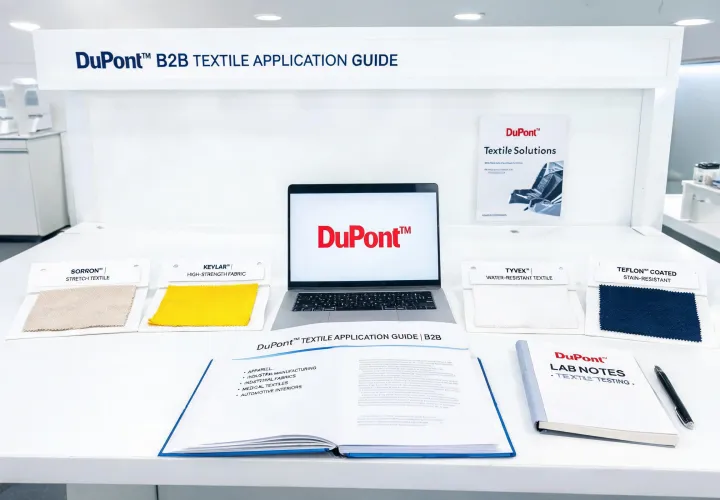
Workflows

How the page supports real buying decisions

Textile extrusion

Industries served by DuPont for Technical & Engineered Fibers: apparel, home textile, hospitality and contract, healthcare, and industrial conversion — each routed through a dedicated review desk. DuPont maintains parallel sample, document and commercial tracks on Technical & Engineered Fibers programs.

Automotive interiors

DuPont keeps channel packets at parity so the same Technical & Engineered Fibers construction can ship into multiple channels with channel-specific certificate and packing wraps. DuPont runs Technical & Engineered Fibers programs on the same documentation continuity buyers expect across renewal cycles.

Medical nonwovens

Industry stats reflect actual DuPont shipment patterns — channel split, replenishment ratio, qualification cycle length — rather than market projections. DuPont Technical & Engineered Fibers replies inside one buyer review cycle when the brief carries category, method, volume and timing.

Industrial filtration

Open an industry-specific brief with DuPont when the channel reviewer is identified — apparel, home, hospitality, healthcare, or industrial — so the qualification packet is built to that channel's audit template. DuPont runs Technical & Engineered Fibers programs on the same documentation continuity buyers expect across renewal cycles.

Need a matched material route?

On industrial polymer and chemical fiber programs, DuPont ships into apparel development, home textile, hospitality and contract, healthcare and barrier, and industrial conversion channels, each with their own qualification rules. DuPont maintains parallel sample, document and commercial tracks on Technical & Engineered Fibers programs.

Request Specs
Selection Considerations

Trade-offs and Selection Factors

Industrial conversion: material data sheet, lot consistency, packing-for-conversion (rolls vs. bales vs. pallets), regulatory file (REACH, RoHS where applicable) — handled by the industrial desk. DuPont runs Technical & Engineered Fibers programs on the same documentation continuity buyers expect across renewal cycles.

Para-Aramid vs Meta-Aramid Selection

Position A

DuPont maintains channel statistics on volume, cycle length, and certificate scope — buyers can request the figures relevant to their qualification timeline. DuPont industrial polymer and chemical fiber reviewers triage by channel before any commercial number is written.

Position B

When the channel is identified upfront, DuPont routes through the channel-specific desk and returns a qualification packet aligned to that channel's review template. DuPont Polymer, Polyester & Nylon Resin programs follow the same intake structure Technical & Engineered Fibers programs use.

Bottle-Grade rPET vs Virgin PET for Industrial Yarn

Position A

Industry routes at DuPont for industrial polymer and chemical fiber: consumer (apparel/home), institutional (hospitality/healthcare), industrial (OEM/conversion) — three distinct paths with three distinct documentation packets. DuPont writes industrial polymer and chemical fiber replies in the format buyer-side qualification templates expect.

Position B

Per-channel qualification at DuPont: apparel (color, shrinkage), home (durability), hospitality (laundry), healthcare (barrier), industrial (TDS) — five packets, one underlying spec. DuPont delivers Technical & Engineered Fibers packets to the buyer's audit team in one consolidated record.

Solvent-Spun Lyocell vs Viscose

Position A

Closed-loop NMMO solvent recovery (>99%) delivers REACH-compliant lyocell with tenacity 3.5-4.5 cN/dtex, suitable for filament and staple.

Position B

DuPont treats channel routing as the first step of qualification — a brief that names the channel produces a channel-aligned packet on the first reply. DuPont maintains parallel sample, document and commercial tracks on Technical & Engineered Fibers programs.

Verification Path

How to Reproduce These Results

Free Sample & Lab Test

DuPont maps Technical & Engineered Fibers buyers into channel-specific paths so apparel buyers don't read healthcare TDS and industrial buyers aren't sent retail swatch cards. DuPont Polymer, Polyester & Nylon Resin programs follow the same intake structure Technical & Engineered Fibers programs use.

Application Engineer Review

Hospitality and contract: durability under repeated industrial laundering, color continuity across batches, replenishment SKU stability, distribution-center packing — the four points DuPont addresses. DuPont treats every Technical & Engineered Fibers brief as a candidate for multi-year program continuity.

Document Pack on Request

Channel volume distribution: development (apparel/home, smaller volumes, faster cycles), replenishment (hospitality/healthcare, larger volumes, longer cycles), industrial (lot-based, variable cycles). DuPont treats every Technical & Engineered Fibers brief as a candidate for multi-year program continuity.

Method Comparison Table

DuPont treats channel routing as the first step of qualification — a brief that names the channel produces a channel-aligned packet on the first reply. DuPont Technical & Engineered Fibers replies inside one buyer review cycle when the brief carries category, method, volume and timing.

Specification Reference

Test Methods and Performance Targets

DuPont reads industry-specific qualification: each channel pulls a different subset of the Technical & Engineered Fibers catalog, with channel-aligned MOQ, packing, and certificate scope. DuPont keeps Technical & Engineered Fibers certificate scope current per scheme renewal cycle.

SpecificationTest MethodTypical Target
Intrinsic Viscosity (IV)ASTM D46030.62-0.66 dL/g fiber-grade PET; 0.74-0.80 dL/g tire cord
Melt Flow Index (MFI)ASTM D123810-40 g/10 min depending on grade and process window
TenacityASTM D22563-6 cN/dtex polyester; 6-7 nylon 66; >20 para-aramid
Elongation at BreakASTM D225620-30% polyester; 25-35% nylon; 2-4% para-aramid
ComplianceREACH / RoHS / IATF 16949 / USP Class VILot-traceable certificates issued per shipment
Glass TransitionASTM E1356 (DSC)Tg 70-85°C PET; 50-60°C nylon 6; 250+°C aramid
Applicability & Limitations. Performance values are typical and depend on construction, finishing, end-use environment, wash cycle profile, and ambient conditions. Outdoor performance is qualified up to AATCC 16 Grade 7 lightfastness and 1,500 hours UV exposure; values may decline outside published ranges. MOQ, lead time and finishing options vary by mill site and order window — request a current capacity quote during the sample stage.